The science

The research,
in plain language.

A Rutgers study tested Synctuition, an earlier version of Beginning. Other research examines nature sounds, music and binaural beats. Here is what those studies found, and what they can tell us.

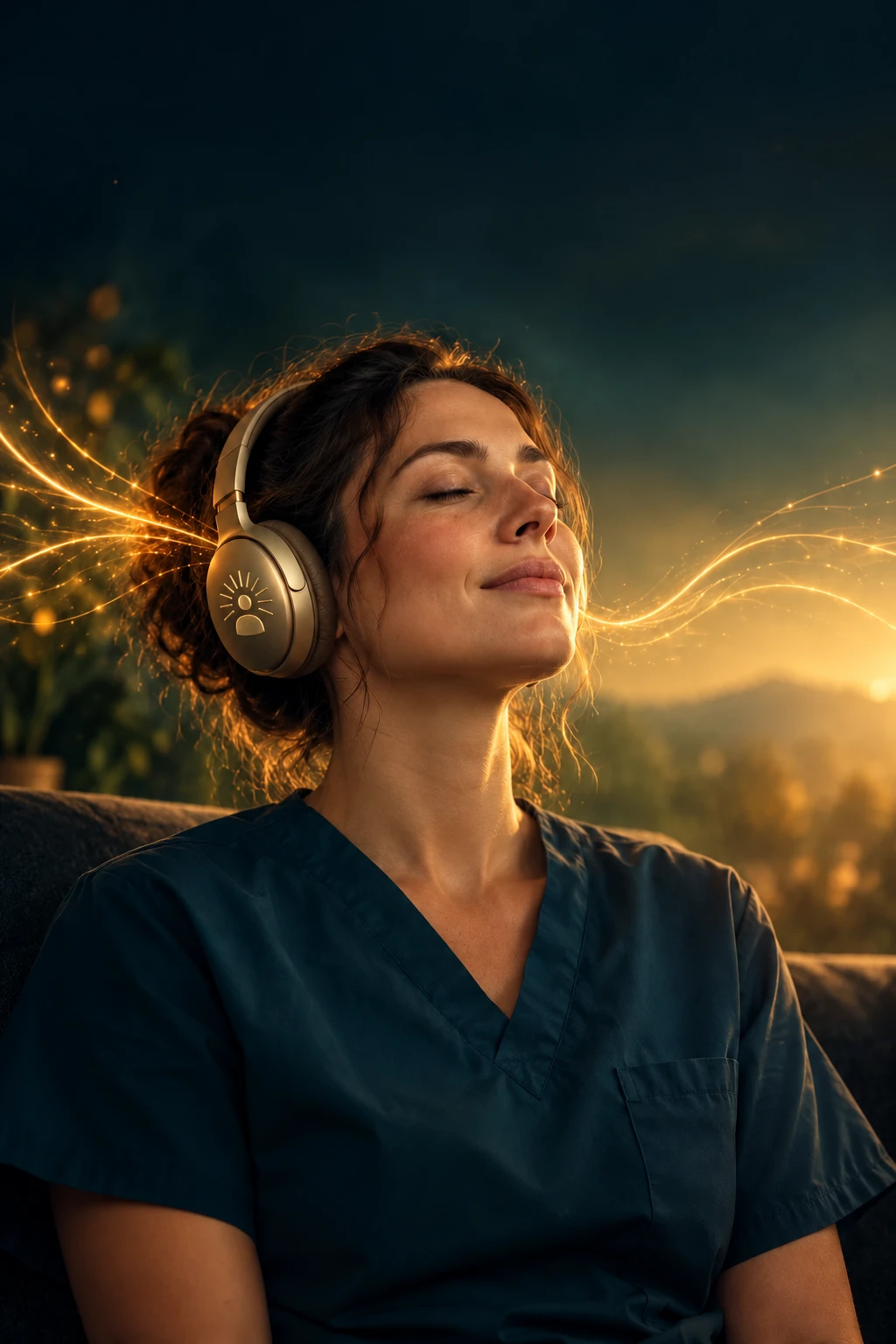
Conceptual artwork of a healthcare professional finding calm through headphones, surrounded by warm golden lightCase study · Rutgers University

100 frontline healthcare workers. 30 days of listening.

The challenge

Doctors, nurses, therapists and technologists under pandemic pressure, with moderate stress at the start.

What they did

Researchers at the Rutgers School of Nursing asked them to listen to Beginning's sound technology for 20 to 30 minutes a day.

The result

Their average score on the Perceived Stress Scale fell from 19.5 to 5.8, from moderate to low stress.

−70%lower average stress score after 30 days

Prado K., Robinson A., Chao Y-Y. "The Impact of Mindful Meditation on Health Care Workers During the COVID-19 Pandemic." The Journal for Nurse Practitioners 19(3), 2023. Single-group study; −70% is the change in mean PSS-10 score. Read the paper

Nature sounds 36

studies reviewed: natural sounds lower stress

A review in PNAS pooled the research on natural sounds and found that natural sounds consistently lowered stress and annoyance.

Buxton R.T. et al., PNAS 118(14), 2021. Source

Listening & sleep 13

trials: nightly listening improves sleep

A Cochrane review of 1,007 adults with insomnia found that listening to music for 25 to 60 minutes a day improved their sleep quality.

Jespersen K.V. et al., Cochrane Database of Systematic Reviews, 2022. Source

Binaural beats 22

studies: less anxiety, no training needed

A meta-analysis found binaural beats eased anxiety and sharpened focus without any practice, and longer listening worked better.

Garcia-Argibay M. et al., Psychological Research 83, 2019. Source

The published study evaluated Synctuition, an earlier version of the app now called Beginning. It measured self-reported stress in one group without a control group; it does not establish that the current app causes the same improvement or improves sleep. The other studies below examine sound or music, rather than Beginning itself.

Inside the sound

What happens when you press play

01 · Nature

Real places, recorded in 3D

Waves, rain, birdsong and fire are recorded where they happen and placed all around you. Research on natural sounds links them with lower stress and annoyance.

02 · Binaural beats

A slightly different tone in each ear

That is why headphones are needed. A meta-analysis of 22 studies found binaural beats eased anxiety, with no training needed. How they work in the brain is still being researched.

03 · No technique

Nothing to learn, nothing to practise

Meditation research shows real benefits for stress, but many people find it hard to start. With Beginning you simply listen for 25 minutes and let the sound do the work.

The Clarity Test

Reflect on how you feel

The Clarity Test is an in-app self-assessment. Use it to reflect on how you feel and compare your responses over time.

You set a baseline in about 15 minutes, then retake it to watch your Clarity Level change as you listen. It is a self-assessment, not a diagnosis.

Read the methodology (PDF)

Six Clarity Levels
  1. Messy
  2. Stormy
  3. Foggy
  4. Bright
  5. Clear
  6. Gifted
Straight talk

What we don't claim

We would rather you trust us than be impressed by us.

  • That Beginning is clinically proven to improve sleep. The Rutgers study measured stress, not sleep.
  • That binaural beats "entrain" your brainwaves. The brain research is still mixed.
  • That any special frequency, such as 432 Hz or 528 Hz, heals the body.
  • That Beginning replaces medical care. If you have ongoing sleep or mental-health problems, please talk to a doctor.
Sources

The evidence, with sources you can verify

The Rutgers paper studied Synctuition, an earlier version of the app now called Beginning. The papers below are background research on sound, sleep and the brain that our sound design draws on. They are not studies of Beginning.

The historical Synctuition study. Prado K., Robinson A. & Chao Y-Y. (2023). The impact of mindful meditation on health care workers during the COVID-19 pandemic. The Journal for Nurse Practitioners 19(3), 104513. Read the paper

Neuroplasticity 3
  1. Maguire E.A. et al. (2000). Navigation-related structural change in the hippocampi of taxi drivers. PNAS 97(8), 4398–4403. doi.org/10.1073/pnas.070039597
  2. Draganski B. et al. (2004). Neuroplasticity: changes in grey matter induced by training. Nature 427, 311–312. doi.org/10.1038/427311a
  3. Pascual-Leone A. et al. (2005). The plastic human brain cortex. Annual Review of Neuroscience 28, 377–401. doi.org/10.1146/annurev.neuro.27.070203.144216
Brain rhythms and binaural beats 6
  1. Buzsáki G. & Wang X-J. (2012). Mechanisms of gamma oscillations. Annual Review of Neuroscience 35, 203–225. doi.org/10.1146/annurev-neuro-062111-150444
  2. Jensen O. et al. (2007). Human gamma-frequency oscillations associated with attention and memory. Trends in Neurosciences 30(7), 317–324. doi.org/10.1016/j.tins.2007.05.001
  3. Garcia-Argibay M. et al. (2019). Efficacy of binaural auditory beats in cognition, anxiety, and pain perception: a meta-analysis. Psychological Research 83(2), 357–372. doi.org/10.1007/s00426-018-1066-8
  4. Becher A-K. et al. (2015). Intracranial EEG power and phase synchronization changes during monaural and binaural beat stimulation. European Journal of Neuroscience 41(2), 254–263. doi.org/10.1111/ejn.12760
  5. McConnell P.A. et al. (2014). Auditory driving of the autonomic nervous system: theta-frequency binaural beats increase parasympathetic activation. Frontiers in Psychology 5, 1248. doi.org/10.3389/fpsyg.2014.01248
  6. Nozaradan S. et al. (2011). Tagging the neuronal entrainment to beat and meter. Journal of Neuroscience 31(28), 10234–10240. doi.org/10.1523/JNEUROSCI.0411-11.2011
Sound, music and emotion 7
  1. Koelsch S. (2010). Towards a neural basis of music-evoked emotions. Trends in Cognitive Sciences 14(3), 131–137. doi.org/10.1016/j.tics.2010.01.003
  2. Chanda M.L. & Levitin D.J. (2013). The neurochemistry of music. Trends in Cognitive Sciences 17(4), 179–193. doi.org/10.1016/j.tics.2013.02.007
  3. Blood A.J. & Zatorre R.J. (2001). Intensely pleasurable responses to music correlate with activity in brain regions implicated in reward and emotion. PNAS 98(20), 11818–11823. doi.org/10.1073/pnas.191355898
  4. Salimpoor V.N. et al. (2011). Anatomically distinct dopamine release during anticipation and experience of peak emotion to music. Nature Neuroscience 14(2), 257–262. doi.org/10.1038/nn.2726
  5. Thaut M.H. et al. (2015). Neurobiological foundations of neurologic music therapy. Frontiers in Psychology 5, 1185. doi.org/10.3389/fpsyg.2014.01185
  6. Mofredj A. et al. (2016). Music therapy, a review of the potential therapeutic benefits for the critically ill. Journal of Critical Care 35, 195–199. doi.org/10.1016/j.jcrc.2016.05.021
  7. Buxton R.T. et al. (2021). A synthesis of health benefits of natural sounds and their distribution in national parks. PNAS 118(14). doi.org/10.1073/pnas.2013097118
Sleep and memory 5
  1. Rasch B. & Born J. (2013). About sleep's role in memory. Physiological Reviews 93(2), 681–766. doi.org/10.1152/physrev.00032.2012
  2. Walker M.P. & Stickgold R. (2006). Sleep, memory, and plasticity. Annual Review of Psychology 57, 139–166. doi.org/10.1146/annurev.psych.56.091103.070307
  3. Tononi G. & Cirelli C. (2014). Sleep and the price of plasticity. Neuron 81(1), 12–34. doi.org/10.1016/j.neuron.2013.12.025
  4. Vyazovskiy V.V. et al. (2008). Molecular and electrophysiological evidence for net synaptic potentiation in wake and depression in sleep. Nature Neuroscience 11(2), 200–208. doi.org/10.1038/nn2035
  5. Jespersen K.V. et al. (2022). Music for insomnia in adults. Cochrane Database of Systematic Reviews. pubmed.ncbi.nlm.nih.gov/36000763/
Meditation and stress 4
  1. Tang Y-Y. et al. (2007). Short-term meditation training improves attention and self-regulation. PNAS 104(43), 17152–17156. doi.org/10.1073/pnas.0707678104
  2. Lazar S.W. et al. (2005). Meditation experience is associated with increased cortical thickness. NeuroReport 16(17), 1893–1897. doi.org/10.1097/01.wnr.0000186598.66243.19
  3. Goyal M. et al. (2014). Meditation programs for psychological stress and well-being: a systematic review and meta-analysis. JAMA Internal Medicine 174(3), 357–368. doi.org/10.1001/jamainternmed.2013.13018
  4. Davidson R.J. et al. (2003). Alterations in brain and immune function produced by mindfulness meditation. Psychosomatic Medicine 65(4), 564–570. doi.org/10.1097/01.PSY.0000077505.67574.E3
Modern life and mental health 4
  1. Lin L.Y. et al. (2016). Association between social media use and depression among U.S. young adults. Depression and Anxiety 33(4), 323–331. doi.org/10.1002/da.22466
  2. Primack B.A. et al. (2017). Social media use and perceived social isolation among young adults in the U.S. American Journal of Preventive Medicine 53(1), 1–8. doi.org/10.1016/j.amepre.2017.01.010
  3. Twenge J.M. & Campbell W.K. (2018). Associations between screen time and lower psychological well-being among children and adolescents. Preventive Medicine Reports 12, 271–283. doi.org/10.1016/j.pmedr.2018.10.003
  4. World Health Organization (2022). World Mental Health Report: transforming mental health for all. who.int/publications/i/item/9789240049338

Full scientific references (PDF)

Where better days begin

Hear it for yourself tonight.

Fifteen nights on us. Put your headphones on and see how good tomorrow can feel.

Explore a business programme →

Explore a programme for your employees, guests or members.